
Phnom Penh Case Study: ROI from Apartments and Condos – 2 Step-by-Step Simulations (Real Numbers)
Phnom Penh Case Study: Calculating ROI on 2 Real Listings Step by Step
Why a Phnom Penh Case Study Only Makes Sense with Numbers
The real estate market in Phnom Penh is one of the most misunderstood markets in Southeast Asia.
On one hand, you hear the narrative: "cheap apartments, high returns."
On the other – real data shows that ROI fails not on purchase price, but on operational assumptions.
That's why this article contains no theory.
There are two simulations based on:
- real market prices,
- actual maintenance costs,
- realistic rental rates,
- and conservative vacancy assumptions.
The goal isn't to "show the best ROI."
The goal is to show where ROI leaks and how to recover it.
Phnom Penh in 30 Seconds – The Most Important Fact (Case Study)
The most important fact:
In Phnom Penh, the difference between gross and net ROI can reach 40–50%.
If you only calculate:
- rent × 12 months
- you're not analyzing an investment, you're making a sales pitch.
Common Assumptions for Both Simulations
To ensure a fair comparison, we're assuming:
- 1-bedroom apartment,
- new or 2–5 year old building,
- districts with real demand (BKK1 / Tonle Bassac),
- long-term rental as baseline,
- 2025/2026 market prices.
Price and rent sources:
https://www.realestate.com.kh/
https://www.cbre.com/insights/figures/asia-pacific
https://www.knightfrank.com.kh/research
CASE STUDY #1 – Conservative Scenario (Stability Over Ambition)
Property Parameters
- Type: 1-bedroom apartment
- Location: Tonle Bassac
- Area: 55 sqm
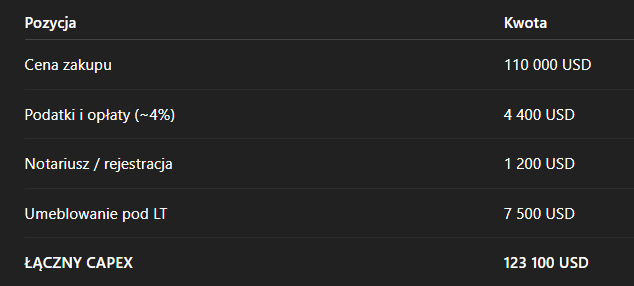
- Purchase price: $110,000 USD
This price corresponds to the $1,900–$2,100 USD/sqm range, which falls within market averages for this district.
CAPEX – Real Entry Cost
Fee sources:
https://www.realestate.com.kh/guides/buying-property-cambodia/
https://www.globalpropertyguide.com/Asia/Cambodia/Buying-Guide
Income – Long-Term Rental
- Market rent: $700 USD / month
- Annual gross: $8,400 USD
Rental data:
https://www.numbeo.com/property-investment/in/Phnom-Penh
https://www.realestate.com.kh/
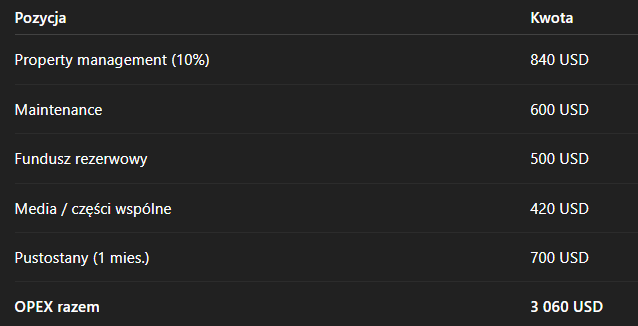
OPEX – Operating Costs (Annual)
Net Result – Conservative Scenario
- Net income: $8,400 − $3,060 = $5,340 USD
- Net ROI: ~4.3%
This is a real, defensive return that:
- holds up in a weaker market,
- doesn't require aggressive management,
- provides liquidity on resale.
The Most Common Myth
"In Phnom Penh you can always achieve 8–10% ROI."
No.
8% ROI is possible:
- with a very good purchase,
- with low CAPEX,
- and with active management.
Market standard is 4–6% net, not brochure promises.
Why This Scenario Works
- low entry barrier,
- realistic rent,
- controlled OPEX,
- expat demand, not tourist.
This is a model that doesn't impress, but makes money.
CASE STUDY #2 – Aggressive Scenario (Higher Income, Higher Risk)
This scenario is the exact opposite of the conservative approach.
Here we're not defending with stability, but trying to squeeze ROI through income, at the cost of:
- greater volatility,
- higher costs,
- greater dependence on the operator.
Property Parameters
- Type: 1-bedroom apartment
- Location: BKK1 (prime)
- Area: 60 sqm
- Purchase price: $145,000 USD
This price corresponds to the $2,300–$2,500 USD/sqm range, typical for top projects in the city center.
Price sources:
https://www.realestate.com.kh/
https://www.knightfrank.com.kh/research
CAPEX – Real Entry Cost (Aggressive)
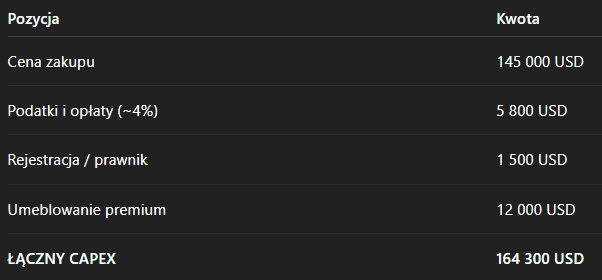
Here you can already see the first difference:
every additional $10,000 USD CAPEX must be "recovered" through rent, and the market isn't always willing to pay for it.
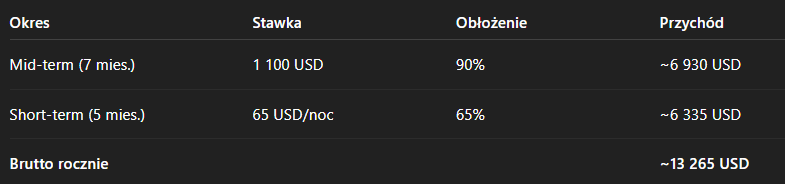
Rental Model – Mixed Short + Mid-Term
Assumption:
- 60% of year – mid-term (1–3 months)
- 40% of year – short-term (business / relocation)
Gross Income – Aggressive Assumptions
Rate sources:
https://www.realestate.com.kh/
https://www.numbeo.com/cost-of-living/in/Phnom-Penh
OPEX – Operating Costs (Aggressive)
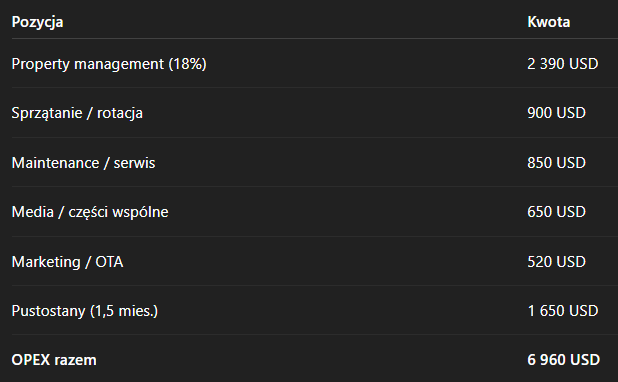
This is the point that most often kills ROI.
Costs rise faster than income.
Net Result – Aggressive Scenario
- Net income: $13,265 − $6,960 = $6,305 USD
- Net ROI: ~3.8%
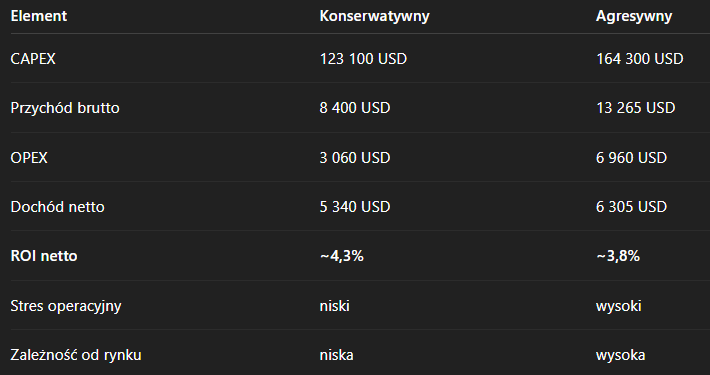
More work, more risk, lower percentage return.
This is a moment that shocks many investors.
Scenario Comparison – In Black and White
Where ROI "Leaks" in Phnom Penh – Key Points
1. CAPEX Above Market Threshold
The Phnom Penh market:
- doesn't reward excessive design,
- doesn't pay linearly for "better finishes."
Every additional $1 USD/sqm:
- increases entry barrier,
- doesn't necessarily increase rent.
2. OPEX Grows Faster Than Income
In aggressive models:
- more turnover,
- more service,
- more management,
- more conflicts.
This is the silent killer of ROI.
3. Vacancies Are Underestimated
The brochure says "full occupancy."
The market says: 1–2 months vacancy is the norm.
If you don't account for them — ROI is fiction.
How to Realistically Approach 8% ROI in Phnom Penh
8% ROI is not standard, but is achievable when:
- you buy below market (off-market / seller pressure),
- you minimize CAPEX (function > design),
- you choose local demand, not tourist,
- you have control over management.
This is exactly the area where Varsovia Estate works with clients:
- not on brochures,
- but on numbers,
- and on real offer selection.
3 Facts You Must Know – Phnom Penh Case Study
Fact 1:
Higher gross income ≠ higher net ROI.
Fact 2:
The safest investments look "ordinary."
Fact 3:
ROI in Phnom Penh is won on purchase, not on management.
Investor Checklist – Phnom Penh ROI (5 Points)
- Is ROI calculated net, after all costs?
- Can CAPEX be defended by market rent?
- Are vacancies calculated realistically?
- Will OPEX increase after 12–24 months?
- Will location defend liquidity in case of resale?
If you don't have an answer to any question — ROI is an assumption, not a result.
Summary – Mathematics Beats Narrative
In Phnom Penh, the winner isn't the one who promises the highest return.
The winner is the one who:
- understands costs,
- calculates net,
- and accepts that stability often beats ambition.
A well-calculated investment:
- earns steadily,
- sells with liquidity,
- and doesn't require constant "result rescue."
Get personalized property recommendations
Our advisor will prepare a selection of properties matching your criteria and budget.
- 3-5 hand-picked properties matching your criteria
- Full cost analysis and investment potential overview
- Free consultation with a dedicated advisor