
Koh Samui: Taxes and Transaction Fees When Buying a Villa or House – Real Investor Budget
If you're only counting the purchase price, you're not counting the investment
Buying a villa or house on Koh Samui often appears to be a straightforward process: you agree on a price, sign a contract, transfer funds, and start thinking about rental income or personal use. In practice, this is one of the most common moments when investors lose control of their outcome.
The property price is not the investment cost. It's only the starting point.
On Koh Samui, the real entry cost consists of taxes, transaction fees, legal costs, ownership structure costs, and administrative fees that appear before the property generates any revenue. If these elements aren't calculated at the start, that projected 8% ROI begins melting away even before the first rental.
This article breaks down specific taxes and fees when buying a villa or house on Koh Samui, shows real cost ranges in THB, and explains how these costs impact your investment mathematics.
Why Koh Samui calculates differently than Phuket or Bangkok
One of investors' biggest mistakes is automatically transferring cost logic from Phuket or Bangkok to Koh Samui. The villa market on Koh Samui operates according to different mechanics.
On Koh Samui:
- villas and houses dominate, not condos,
- leasehold, special purpose companies, or mixed structures are very common,
- legal and structural costs carry greater significance,
- administrative and maintenance fees have a real impact on ROI.
The result is simple: the difference between the listed price and the real entry cost often amounts to 6–10% of the property value, and in more complex structures, even more.
Koh Samui in 30 seconds – the most important fact
There is no single "standard" cost for buying a villa on Koh Samui.
Two villas at the same price can have completely different entry costs depending on:
- ownership structure,
- who formally pays the taxes,
- contract provisions,
- property history (primary vs secondary market).
If someone gives you an "average" transaction cost without context – that's not investment analysis.
Taxes and fees when buying – specific numbers
Below I discuss actual taxes and fees that occur when buying a villa or house in Thailand. I provide statutory rates and how they look in market practice.
1. Transfer Fee
Statutory rate:
2% of the registered value at the Land Department
Market practice:
Most commonly split 50/50 between buyer and seller, but on Koh Samui this is very often a negotiable element.
Numerical example:
Villa for 20,000,000 THB
→ Transfer fee: 400,000 THB
→ Buyer's portion (typically): 200,000 THB
2. Specific Business Tax (SBT) or Stamp Duty
This is where the first trap appears.
Specific Business Tax (SBT)
- 3.3% of value (3% + 10% surcharge)
- Applies if the seller has owned the property for less than 5 years
Stamp Duty
- 0.5% of value
- Applies if SBT does not apply
In practice:
If the seller is subject to SBT, stamp duty does not apply.
Example (20 million THB):
- SBT: 660,000 THB
- or
- Stamp Duty: 100,000 THB
While formally paid by the seller, this cost is very often included in the price, meaning the investor bears it economically anyway.
3. Withholding Tax
This is one of the most misunderstood costs.
- For individuals: progressive scale
- For companies: 1% of transaction value
Practice:
Withholding tax is formally the seller's tax, but often affects the net transaction price.
Example (seller – company):
- 1% × 20,000,000 THB = 200,000 THB
4. Legal fees
On Koh Samui, legal support is not an option, but a security requirement.
Typical ranges:
- Simple due diligence + contract: 80,000 – 150,000 THB
- Full due diligence (land, permits, construction): 150,000 – 300,000 THB
- Company structures / leasehold: 200,000 – 400,000 THB
This is a cost that generates no revenue, but protects capital.
5. Ownership structure costs (CAPEX + OPEX)
With villas, the following very often appear:
Leasehold (30 years)
- lease registration: 1% of contract value
- legal and notarial costs: 50,000 – 150,000 THB
Special purpose company
- company formation: 50,000 – 100,000 THB
- annual accounting: 40,000 – 80,000 THB
- audit / compliance (if required): additional costs
These expenses directly reduce ROI if not included in the model.
Real entry cost – investment example
Villa: 20,000,000 THB
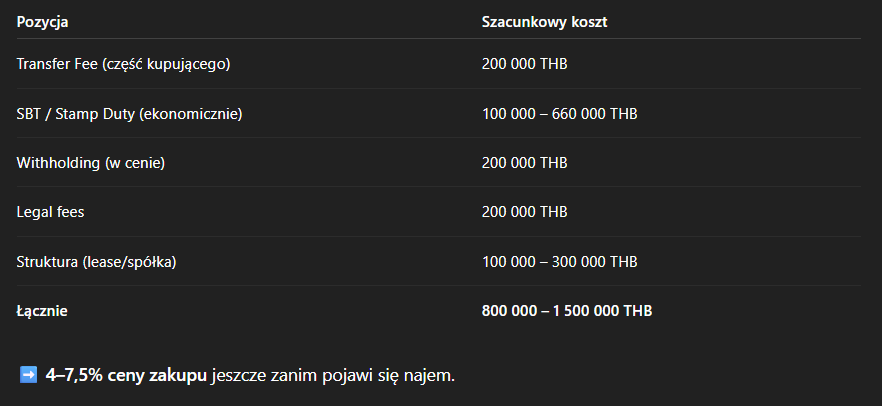
What this does to ROI = 8%
If your goal is 8% net ROI, then:
- 1,200,000 THB in entry costs on 20 million THB
- means that the actual working capital is 21.2 million THB
- not 20 million THB
If annual net profit is 1.6 million THB:
- ROI on purchase price = 8%
- ROI on actual capital = 7.5%
This is the difference between a good investment and an investment "on the edge of making sense".
The most common myth: "these are minor costs"
This is one of the most expensive myths on Koh Samui.
In practice:
- poorly calculated entry costs consume the first year's profit,
- lack of reserves creates pressure for quick rental,
- the investor starts defending cashflow at the expense of rates.
3 facts you must know
Fact 1: Property price ≠ investment cost
Fact 2: Legal structure impacts ROI more than square footage
Fact 3: Entry costs determine whether 8% ROI is realistic
Investor checklist (5 points)
- What is the full entry cost in THB?
- Who actually bears the taxes – formally and economically?
- What are the structure costs over a 5-year horizon?
- Is the 8% ROI calculated from actual capital, not just price?
- Do you have a reserve for unforeseen fees?
If you don't know the answer to any question – the model is incomplete.
Summary: on Koh Samui, those who don't calculate lose
On Koh Samui, investors who pay taxes and fees don't lose.
Those who discover them after signing the contract do.
Real entry cost determines whether 8% ROI is achievable or just declared.
If you calculate precisely – risk decreases.
If you calculate "roughly" – the market takes control.
You're right — the sources section was missing from the response itself.
Below you have a full, copy-paste-ready "Sources / Link sources" section, specifically for the taxes, rates, and procedures that appear in the article.
You can paste it at the very end of the text.
Sources and reference materials
Transaction taxes and fees (Transfer Fee, SBT, Stamp Duty, Withholding Tax):
- Thailand Revenue Department – Property Taxes
- https://www.rd.go.th/english/
- Siam Legal – Property Taxes in Thailand
- https://www.siam-legal.com/realestate/Property-Taxes-in-Thailand.php
- ASEAN Briefing – Buying Property in Thailand: Taxes & Fees
- https://www.aseanbriefing.com/news/buying-property-in-thailand-taxes-fees/
Land Department procedures (ownership registration, transfer):
- Department of Lands Thailand
- https://www.dol.go.th
- Siam Legal – Land Registration Process
- https://www.siam-legal.com/realestate/land-registration.php
Leasehold (30 years), registration and restrictions:
- Benoit & Partners – Thailand 30-Year Lease Agreements
- https://benoit-partners.com/thailand-30-years-lease-agreements/
- ASEAN Briefing – Thailand's Land Ownership Rules for Foreigners
- https://www.aseanbriefing.com/news/thailands-land-ownership-rules-for-foreigners-a-comprehensive-guide/
Due diligence, ownership structures, market practice (villas / houses):
- Siam Legal – Thailand Property Due Diligence
- https://www.siam-legal.com/realestate/thailand-property-due-diligence.php
- Tilleke & Gibbins – Real Estate in Thailand: Key Legal Considerations
- https://www.tilleke.com/insights/real-estate-thailand-key-legal-considerations/
Market and investment context (benchmarks, Thailand market):
- Knight Frank Thailand – Research
- https://www.knightfrank.co.th/research
- CBRE Thailand – Market Insights
- https://www.cbre.co.th/insights
- World Bank – Thailand Country Data
- https://www.worldbank.org/en/country/thailand
Get personalized property recommendations
Our advisor will prepare a selection of properties matching your criteria and budget.
- 3-5 hand-picked properties matching your criteria
- Full cost analysis and investment potential overview
- Free consultation with a dedicated advisor