
Phnom Penh: Who Rents Apartments and Condos? Tenant Profile and Real Demand (2026)
Introduction: In Phnom Penh, You Don't Rent to "the Market" — You Rent to People
In Phnom Penh, demand for apartments and condos isn't an abstract statistic.
It's real people, with specific budgets, lifestyles, and time horizons.
That's why investors who copy strategies from Phuket, Dubai, or Bali fail at the product selection stage.
Not because the market is weak — but because it's different.
This article shows:
- who actually rents in Phnom Penh,
- what they pay,
- what they expect,
- and how these profiles translate into ROI.
No theory. Just numbers.
Phnom Penh in 30 Seconds – The Most Important Fact
Phnom Penh is a long-term rental market driven by expatriate and corporate demand,
not a tourist market.
This single statement should determine your entire investment choice:
size, standard, location, and rental strategy.
Rental Demand Structure in Phnom Penh (2025–2026)
Based on market data and operational practice, demand divides into 5 main groups:
1. Corporate Expats and Managers (30–35%)
Who they are:
- management staff (banking, FMCG, manufacturing),
- ASEAN regional managers,
- 12–36 month contracts.
What they expect:
- 1BR or 2BR,
- good acoustics, elevator, security,
- parking, gym, reception,
- proximity to BKK1 / Tonle Bassac.
Budgets (2025/2026):
- 1BR: $700–$1,000/month
- 2BR: $1,000–$1,400/month
Sources:
👉 The most stable rental segment.
2. International Organizations and NGOs (20–25%)
Who they are:
- UN, ADB, WHO staff,
- embassies, foundations,
- 6–24 month contracts.
What they expect:
- security,
- predictable costs,
- well-managed buildings,
- often "neutral" furnishing, not lifestyle-focused.
Budgets:
- Studio / 1BR: $600–$900
- 2BR: $900–$1,200
👉 Highly loyal tenants, low turnover.
3. Individual Expats and Specialists (20%)
Who they are:
- IT, consulting, fintech,
- regional startups,
- singles or couples.
What they expect:
- modern design,
- fast internet,
- proximity to cafes and coworking spaces,
- flexible leases (6–12 months).
Budgets:
- Studio: $500–$650
- 1BR: $650–$850
Sources:
4. Premium Local Tenants (10–15%)
Who they are:
- Cambodia's middle and upper class,
- local managers,
- often families.
What they expect:
- 2BR,
- parking,
- good building reputation,
- moderate rents.
Budgets:
- 2BR: $700–$1,000
👉 Price-sensitive segment, but growing.
5. Short-Term Rentals (5–10%)
Who they are:
- business travelers,
- short projects,
- "transitional" relocations.
Budgets:
- $40–$90/night
Sources:
👉 NOT the core of the market.
How Tenant Profile Impacts Unit Size
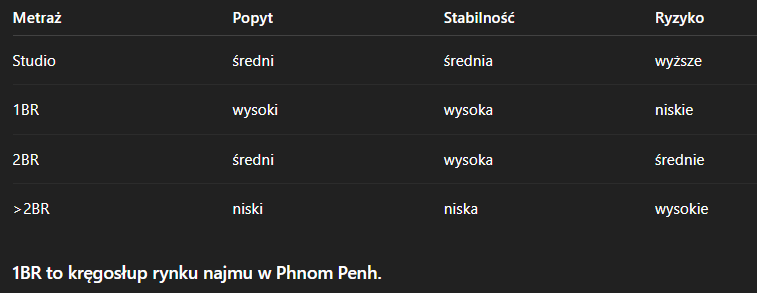
Costs Tenants "See" (That Investors Must Anticipate)
Tenants in Phnom Penh actively compare total cost of living, not just rent.
Typical Monthly Costs (1BR):
- Rent: $700–$900
- Electricity (AC): $80–$140
- Water: $5–$10
- Internet: $25–$40
- Parking: $0–$50
Sources:
👉 If your offering "exceeds" the market with additional costs — demand drops.
The Most Common Myth About Phnom Penh
"A nice apartment is enough — tenants will come."
Wrong.
Phnom Penh's market rewards function and location,
and penalizes excessive design without practical logic.
3 Facts You Must Know – Phnom Penh
- This is a residential, not tourist market
- Stable rent > maximum rate
- 1BR in a good district beats 2BR in a poor one
Investor Checklist
✔ Does the product match a specific tenant profile?
✔ Does the rent fit within the segment's real budget?
✔ Do additional costs not kill competitiveness?
✔ Does the location match the tenant's lifestyle?
Tenant Profile by District – Where Demand Is Real in Phnom Penh
In Phnom Penh, demand is not geographically uniform.
The same apartments, at the same standard, can have completely different occupancy rates and rental prices depending on the district.
BKK1 (Boeng Keng Kang 1)
Tenant profile:
- corporate expats,
- embassies, NGOs,
- management staff.
Why it works:
- restaurants, offices, embassies,
- best pedestrian infrastructure,
- perceived as "safe" and prestigious.
Rates (2025/2026):
- 1BR: $800–$1,000
- 2BR: $1,100–$1,500
Long-term occupancy: 85–95%
Sources:
https://www.cbre.com/insights/figures/asia-pacific
https://www.knightfrank.com.kh/research
👉 Lowest risk, lower gross ROI, highest stability.
Tonle Bassac
Tenant profile:
- younger expats,
- consulting, fintech,
- couples, singles.
Why it works:
- modern projects,
- close to BKK1, but cheaper,
- lifestyle + functionality.
Rates:
- Studio: $550–$700
- 1BR: $650–$850
Occupancy: 80–90%
Sources:
https://www.realestate.com.kh/
https://www.numbeo.com/cost-of-living/in/Phnom-Penh
👉 Best risk/return ratio for 1BR.
Chroy Changvar
Tenant profile:
- long-term expats,
- project workers,
- budget-conscious tenants.
Why it can be problematic:
- weaker connectivity,
- less infrastructure,
- bridge dependency.
Rates:
- 1BR: $500–$650
- 2BR: $700–$900
👉 Only for investors prioritizing purchase price, not demand.
How Demand Impacts Real ROI (Numbers)
Base Model – 1BR in Tonle Bassac
Purchase:
- Price: $120,000
- Transaction costs (~4%): $4,800
- Furnishing: $8,000
Total CAPEX: $132,800
Long-term rental:
- Rent: $750
- Annual: $9,000
Annual OPEX:
- Management (10%): $900
- Maintenance: $600
- Reserve fund: $500
- Vacancy (1 month): $750
Net: $6,250
Net ROI: ~4.7%
👉 Stable, defensive, predictable.
Alternative Model – Mid-term + Short-term Mix
Average revenue:
- 9 months LT: 750 × 9 = $6,750
- 3 months ST: $65 × 70% = $4,095
Gross: $10,845
Higher OPEX:
- Management: $1,600
- Service/cleaning: $900
- Utilities: $700
Net: ~$7,600
Net ROI: ~5.7%
Short-term sources:
Why ROI in Phnom Penh Isn't "Tourist-Driven"
Phnom Penh doesn't pay for seasonality, it pays for stability.
Tenants:
- work,
- have contracts,
- don't rotate weekly.
Therefore:
- 8% ROI is only possible with a very good purchase,
- market standard is 4–6% net,
- "brochure" investors burn through cashflow.
The Most Common Myth About Phnom Penh
"Short-term always yields more."
Not in this city.
Short-term:
- increases OPEX,
- raises vacancy risk,
- requires operational control.
Long-term:
- stabilizes cashflow,
- protects margin,
- increases liquidity on resale.
3 Facts You Must Know
- Demand is location-specific, not "city-wide"
- The best rental is a boring rental
- ROI favors functional products
Complete Investor Checklist – Phnom Penh
✔ Have you chosen a district matching the tenant profile?
✔ Does the rent fit within the market's real budget?
✔ Does OPEX not consume the price advantage?
✔ Will the product withstand vacancies?
✔ Are you calculating ROI net, not from a presentation?
Summary: Who Actually Rents in Phnom Penh
In Phnom Penh, success doesn't go to those who build visions,
but to those who understand the tenant.
The best investments:
- aren't spectacular,
- are logical,
- work without emotion.
If you match:
- the right district,
- the right size,
- the right tenant profile,
then the market does the rest for you.
SOURCES
https://www.cbre.com/insights/figures/asia-pacific
https://www.knightfrank.com.kh/research
https://www.realestate.com.kh/
Get personalized property recommendations
Our advisor will prepare a selection of properties matching your criteria and budget.
- 3-5 hand-picked properties matching your criteria
- Full cost analysis and investment potential overview
- Free consultation with a dedicated advisor