
Phuket Property Due Diligence: 15 Essential Questions Before Your Deposit (Investor Checklist)
Phuket Property Due Diligence: 15 Essential Questions Before Your Deposit
Without Due Diligence, You're Buying Marketing – Not Real Estate
Purchasing a condo in Phuket often begins with emotion: prime location, stunning pool, sleek renderings, promises of "hands-free rental income." In reality, however, investment success isn't determined by what you see in presentations, but by what you verify before signing the reservation agreement.
Due diligence in Phuket isn't a formality. It's a process that:
- protects your capital,
- clarifies true costs,
- filters out "beautiful but risky" projects,
- and enables realistic ROI calculations (not brochure returns).
Below are 15 questions every investor should ask before signing contracts and transferring funds. You can literally copy this checklist and use it in conversations with developers, agents, or lawyers.
Phuket in 30 Seconds: The Critical Fact
The costliest investment mistakes in Phuket don't stem from purchase price – they come from overlooked legal and operational details.
If something:
- isn't in writing,
- isn't clearly calculated,
- or "usually works out,"
then it doesn't exist from an investor's perspective.
15 Due Diligence Questions – Legal and Operational
1. What is the Legal Status of the Land and Building?
A fundamental question that's still frequently overlooked.
Verify:
- whether the project has Chanote title (most secure ownership),
- whether the building has legal permits (Building Permit + EIA),
- whether there are zoning restrictions.
Legal verification cost (lawyer DD):
30,000 – 60,000 THB depending on scope.
2. Are You Purchasing in Foreign Quota (49%) or Thai Quota?
For Thai condominiums:
- only 49% of project space can be foreign-owned,
- the remaining 51% is Thai quota.
If you purchase a unit in Thai quota:
- you cannot own it directly as a foreign individual,
- intermediate structures are required (company / leasehold / nominee).
This is a critical risk that must be clearly defined before reservation.
3. Is Foreign Quota Actually Available in This Project?
A common issue in popular Phuket locations.
Marketing says: "foreign quota available."
Reality: quota exhausted, offer refers to Thai quota.
Request:
- written confirmation of foreign quota availability,
- specific unit number assigned to foreign quota.
No confirmation = red flag.
4. What is the Total Purchase Price, Not Just the Listed Price?
The advertised price is never the total entry cost.
Add to the base price:
- transfer fees and taxes,
- legal costs,
- administrative charges,
- furnishings.
Typical transaction costs for Phuket condos:
~3% – 5% of purchase price.
5. Who Pays Transfer Fees and Taxes?
Standard Thai fees include:
- Transfer Fee: 2% of value (often split 50/50),
- Specific Business Tax: 3.3% (if seller meets conditions),
- Stamp Duty: 0.5% (alternatively),
- Withholding Tax: depends on seller.
In practice:
- cost allocation is negotiable,
- but must be clearly stated in the contract.
6. What Are the Legal and Registration Costs?
Legal representation isn't a luxury – it's minimum protection.
Market rates:
- contract + registration: 25,000 – 40,000 THB,
- full due diligence: 40,000 – 60,000 THB.
If someone says "you don't need a lawyer," they're saving your money... for themselves.
7. What is the Maintenance Fee?
Maintenance fees in Phuket directly impact ROI.
Typical rates:
- 40 – 80 THB / m² / month
For 40 m²:
- ~19,000 – 38,000 THB annually
Verify:
- what's included,
- whether sinking fund is incorporated,
- fee increase history.
8. Is There a Sinking Fund?
Sinking fund is a one-time payment at purchase.
Typically:
- 500 – 1,000 THB / m²
For 40 m²:
- 20,000 – 40,000 THB one-time
No fund = risk of sudden future assessments.
The Most Common Phuket Myth: "It's a Standard Process, Same Everywhere"
No.
Phuket means:
- different developers,
- different legal structures,
- different rental regulations,
- different costs hidden in fine print.
If you treat due diligence as a formality, you surrender control over your investment.
3 Facts You Must Know (Phuket Due Diligence)
Fact 1:
The costliest mistakes emerge after deposit, not before.
Fact 2:
Foreign quota is the foundation of ownership security.
Fact 3:
Fixed costs matter more than purchase price when calculating ROI.
15 Due Diligence Questions – Rental, Contracts, and Risks
9. Do Building Regulations Allow Short-Term Rentals?
One of the most frequently overlooked questions that can destroy your entire calculation.
Verify:
- whether short-term rental (<30 days) is permitted,
- whether hotel license is required,
- whether the juristic person has imposed operational restrictions.
In Phuket, increasingly more projects:
- formally permit only 30+ day rentals,
- or tolerate shorter stays "conditionally."
If your ROI model relies on Airbnb and regulations are ambiguous — legal risk transfers to the investor.
10. What is the Actual Payment Schedule?
In off-plan projects, the payment schedule can be riskier than the price.
Typical structure:
- reservation: 100,000 – 200,000 THB (often non-refundable),
- contract: 20–30%,
- construction installments,
- balance at handover.
Verify:
- refund conditions if project delays,
- developer penalties (often symbolic),
- whether dates are "indicative" or binding.
11. What Are Furnishing and Rental Preparation Costs?
Condos sold as "fully furnished" very often:
- don't meet rental standards,
- require additional equipment.
Realistic ranges:
- basic upgrade: 120,000 – 200,000 THB,
- full rental preparation: 200,000 – 350,000 THB.
These costs must be included in CAPEX, otherwise ROI is artificially inflated.
12. What Does Rental Management Cost?
Most common Phuket models:
- 20–25% of gross revenue (short-term),
- 10–15% of rent (long-term).
Additionally, often includes:
- cleaning: 500–800 THB / stay,
- laundry,
- minor repairs,
- call-out fees.
No clear management agreement = no cost control.
13. What Are Utility and Operating Costs?
Average annual costs for 1BR condo:
- electricity: 18,000 – 30,000 THB,
- water: 3,000 – 6,000 THB,
- internet / TV: 6,000 – 12,000 THB.
If air conditioning runs intensively (short-term), costs rise faster than rental income.
14. Does the Project Have a History of Fee Increases?
Ask:
- what maintenance fees were 3–5 years ago,
- whether sinking fund has been replenished,
- whether major works are planned (facade, elevators, pool).
No data = no OPEX predictability.
15. What is the Actual Resale Liquidity?
This question closes the due diligence process.
Verify:
- how many similar units are currently on the secondary market,
- how long listings remain active,
- whether foreign quota still has demand in this project.
No liquidity = ROI "on paper" only.
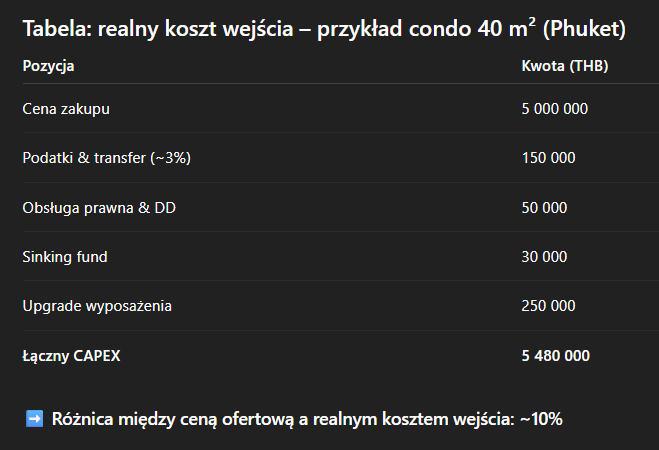
How Due Diligence Impacts Real ROI (~8%)
With a well-selected Phuket project:
- annual gross revenue: 550,000 – 650,000 THB,
- OPEX (management, utilities, maintenance): 35–45%,
- net result: 300,000 – 350,000 THB.
With CAPEX ~5.4M THB:
- Net ROI: ~5.5–6.5% without optimization,
- ~7.5–8% with:
- professional management,
- minimized vacancy,
- realistic seasonal modeling.
ROI isn't improved by marketing, but by cost control.
Investor Checklist: Phuket Due Diligence (5 Points)
- Is the unit in foreign quota – confirmed in writing?
- Do I know the total CAPEX, not just the price?
- Do building regulations permit my rental model?
- Are fixed costs calculated conservatively?
- Do I know who will buy this property from me in 5 years?
If the answer to any question is "I don't know" — don't deposit.
Summary: Due Diligence Is Your Only Real Investment Advantage
In Phuket, investors don't lose because they pay taxes and fees.
They lose because they discover them after the deposit.
Professional due diligence:
- reduces risk,
- stabilizes ROI,
- and separates investment from emotional purchasing.
Sources
Get personalized property recommendations
Our advisor will prepare a selection of properties matching your criteria and budget.
- 3-5 hand-picked properties matching your criteria
- Full cost analysis and investment potential overview
- Free consultation with a dedicated advisor