
Sihanoukville: 7 Mistakes When Buying an Apartment or Condo and How to Avoid Them
Why Sihanoukville Is a "High-Amplitude Error" Market
Sihanoukville is a market where mistakes cost more and happen faster than in Phnom Penh. The reason is simple: the city has experienced dramatic boom-correction cycles in recent years, and much of the supply was built without genuine end-user demand.
An apartment or condo in Sihanoukville can be:
- an excellent value opportunity,
- or an asset that generates no liquidity or rental income for years.
The difference doesn't come from the purchase price, but from the quality of the investor's decision. Below, I break down the 7 most common mistakes that genuinely destroy ROI.
Mistake #1: Buying Location "from a Map" Rather Than from Demand
The most common mistake in Sihanoukville is believing that:
"close to the beach = demand"
In practice:
- many beachfront locations have no year-round tenant demand,
- daily infrastructure is missing: offices, schools, shops, services,
- short-term demand is irregular and seasonal.
Financial consequence:
An apartment purchased 10–15% cheaper may generate 0–2% net ROI instead of 6–8%.
Cost of mistake (annually):
- vacancy periods: 3–6 months,
- lost income: $2,500–$4,000 USD annually for a 1BR unit.
Mistake #2: Ignoring the Real Entry Cost (CAPEX)
The purchase price in Sihanoukville is never the full investment cost.
Typical entry costs for a condo:
- transfer tax: 4% of contract value,
- notary and registration fees: $500–$1,000 USD,
- legal due diligence: $800–$1,500 USD,
- furnishing for rental:
- studio: $5,000–$7,000 USD,
- 1BR: $7,000–$10,000 USD,
- 2BR: $10,000–$15,000 USD.
Investor mistake: calculating ROI solely from the listed price.
Effect: ROI on paper 8–9%, actually 4–5% or less.
Mistake #3: Buying "Cheap" in a Project Without Liquidity
In Sihanoukville, a low price per sqm very often means:
- project without management,
- no owners' association,
- low standard of common areas,
- problems with technical service.
Example price differences (2025/2026):
- liquid projects: $1,400–$1,800 USD/sqm,
- problematic projects: $900–$1,100 USD/sqm.
Hidden cost of cheap purchase:
- actual maintenance (not declared): $1.5–$2.5 USD/sqm/month,
- emergency repairs: $1,000–$2,000 USD annually.
Mistake #4: Failing to Verify Title of Ownership (Strata Title)
In Sihanoukville, not every "condo" actually has strata title.
Risks:
- soft title instead of hard title,
- no separate unit titles issued,
- incomplete registration procedure for the building as co-owned.
Cost of mistake:
An apartment not qualifying for foreign ownership loses:
- liquidity,
- ability to sell to foreigners,
- access to financing.
Market discount on resale: –20% to –40%.
Mistake #5: Assuming "Automatic" Short-Term Rental Income
Project marketing often promises:
- "guaranteed rental",
- "consistent occupancy",
- "hands-free profit".
Operational reality:
- actual short-term occupancy: 40–55% annually,
- operator commission: 20–30% of gross revenue,
- utilities and service: $120–$180 USD/month.
Effect:
Gross revenue looks good, net return shrinks.
Mistake #6: No Operating Reserve (Cash Buffer)
In Sihanoukville, lack of reserves isn't a risk—it's a guarantee of problems.
Minimum safe reserve:
- 6 months of fixed costs,
- typically: $2,000–$3,500 USD per unit.
Without reserves, the investor:
- lowers rates under pressure,
- shortens investment horizon,
- loses negotiating position when selling.
Mistake #7: Calculating ROI "Like in the Developer's Excel"
The most common final mistake:
- calculating gross ROI,
- ignoring CAPEX and OPEX,
- no stress scenario.
Safe benchmark for Sihanoukville (net):
- short-term: 5–7%,
- long-term: 4–6%,
- above 8% → high risk in assumptions.
Sihanoukville in 30 Seconds: The Most Important Fact
Sihanoukville doesn't forgive structural mistakes.
A good purchase works consistently. A bad one—doesn't work at all.
The Most Common Myth About Sihanoukville
"If I buy cheaper, I'll always come out ahead."
Entry price does not compensate for poor liquidity, lack of demand, and operating costs.
3 Facts You Must Know
- Cheap price ≠ good investment
- Liquidity is more important than view
- ROI is counted net, not from a brochure
Investor Checklist (Introduction)
- Does the project have strata title?
- What are the real annual costs?
- Who is the actual tenant, not the marketing one?
- What does resale look like, not purchase?
- Can ROI survive 12 months without rental?
Sources (for further article sections)
- https://www.cbre.com.kh
- https://www.worldbank.org/en/country/cambodia
- https://www.gdc.gov.kh
- https://www.mef.gov.kh
- https://www.knightfrank.com/research
Legal Status and Ownership
- Does the unit have strata title (hard title) assigned to a specific unit?
- Is the building formally registered as a co-owned building?
- Can foreigners own >1st floor (excluding ground floor and basement)?
- Are there developer mortgages on the property?
Entry Costs (CAPEX)
- What is the full gross purchase cost (price + 4% transfer tax)?
- Are notary fees flat or percentage-based?
- Is furnishing included, or does it require a separate budget?
Fixed Costs (OPEX)
- Maintenance fee: how much USD/sqm/month actually, not in the brochure?
- Utilities during vacancy: how much monthly without rental?
- Sinking fund: does it exist and what is the amount?
Rental and Demand
- Who is the actual tenant (port worker, expat, tourist)?
- What is the average vacancy period per year?
- What rates are achievable, not "target"?
Exit Strategy
- How long does it actually take to sell similar units?
- What price do secondary market transactions achieve, not listings?
- Who buys: local or foreign investors?
Real Costs Most Often Overlooked
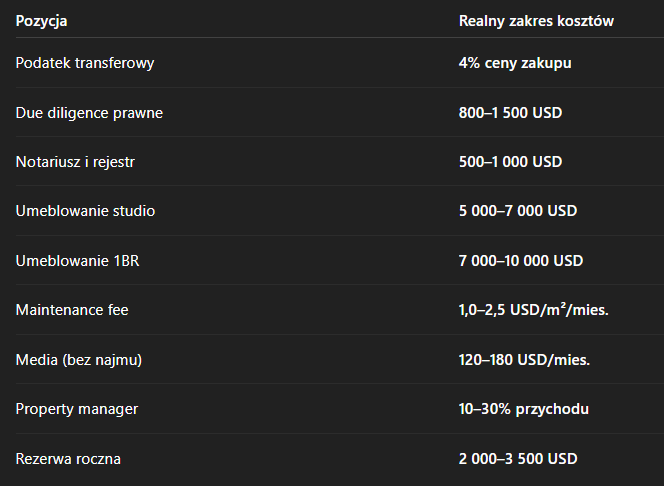
What "Healthy" Math Looks Like in Sihanoukville
A safe investment in Sihanoukville doesn't maximize ROI, it minimizes risk of error.
Profile of a healthy project:
- purchase price: $1,300–$1,700 USD/sqm,
- maintenance ≤ $1.5 USD/sqm,
- year-round demand (not just tourism),
- strata title + active community.
Realistic net ROI (2026):
- long-term: 4–6%,
- short-term: 5–7%,
8% = aggressive assumptions or structural risk.
Most Common Warning Signs (Red Flags)
If you see any of the following points — stop the process:
- "Guaranteed rental" without historical reports
- No clear information about maintenance fees
- Price significantly below market without explanation
- Sale "on soft title with promise of conversion"
- No secondary market for similar units
Investor Defensive Strategy (How NOT to Lose)
Instead of asking:
"How much can I earn?"
Ask yourself:
- How long can I maintain the unit without rental?
- Will I sell it in 90 days or 24 months?
- Will this project survive the next correction cycle?
In Sihanoukville, capital preservation is more important than aggressive growth.
Sihanoukville in 30 Seconds – Summary
This is a market where:
- good decisions work consistently,
- bad decisions don't work at all,
- cheap doesn't mean safe.
Most Common Myth (Finally Debunked)
"Just buy cheap and the market will do the rest."
It won't.
In Sihanoukville, the market rewards selection, not enthusiasm.
3 Facts You Must Remember
- ROI without costs is fiction
- Liquidity > view > price
- If you don't have an exit plan—you don't have an investment
Investor Checklist – Final Version (5 Points)
- Strata title confirmed by documentation
- CAPEX + OPEX calculated conservatively
- Actual demand, not marketing claims
- Financial reserve for 6 months
- Sale scenario planned before purchase
Sources and Market Data
- CBRE Cambodia – MarketView
- https://www.cbre.com.kh
- Knight Frank Cambodia Reports
- https://www.knightfrank.com/research
- World Bank Cambodia Data
- https://www.worldbank.org/en/country/cambodia
- General Department of Taxation Cambodia
- https://www.gdt.gov.kh
- Ministry of Economy and Finance
- https://www.mef.gov.kh
Get personalized property recommendations
Our advisor will prepare a selection of properties matching your criteria and budget.
- 3-5 hand-picked properties matching your criteria
- Full cost analysis and investment potential overview
- Free consultation with a dedicated advisor