
Thailand Leasehold (30 Years): What You Actually Get vs. What You DON'T Buy (Koh Samui Examples)
Thailand Leasehold (30 Years): What You Actually Get vs. What You DON'T Buy
Leasehold Isn't "Quasi-Ownership" — It's a Specific Right with a Hard Ceiling
If you're investing in villas and houses on Koh Samui, the word "leasehold" appears faster than any discussion about ROI. And rightfully so, because leasehold is a real legal and market instrument in Thailand. The problem starts when leasehold is marketed as something it's not: "almost ownership," "90 years guaranteed," "it's just a formality because they always renew."
Legally, the matter is straightforward: standard property lease (hire of immovable property) has a 30-year limit. If a contract attempts to offer more, from a legal and registration perspective, that period is reduced to thirty years. This is the critical point that separates what you "have" from what is merely a promise.
The second equally important thing: leasehold exceeding 3 years must be registered at the Land Office to be enforceable against third parties and viable long-term. In practice, this means the documents and contract structure must pass through the office, not just "look good" in a PDF.
This article has one goal: to build a simple roadmap in your mind. After reading, you should be able to answer:
- what exactly you get for 30 years,
- what you don't buy even when someone writes it into the contract,
- how to recognize structures that look "clever" but are risky,
- and which clauses most commonly harm investors.
This is not legal advice. This is investment material: how to think, what to verify, and where the red flags are.
Koh Samui in 30 Seconds: Thailand — The Most Important Fact
The most important fact about leasehold in Thailand is this: you have a solid right to use the property for the registered lease term (up to 30 years), but you have no guarantee of "automatic" renewals signed in advance. In investment practice, this means your asset's value after year 30 depends on the market, the landowner's willingness, and the structure of safeguards — not on marketing.
What Exactly You Get with Leasehold (and What Stays with the Landowner)
Leasehold isn't "nothing." It's a very specific contractual (obligatory) right to use property for a defined period under conditions described in the agreement.
In simplified terms, you get:
- right to use the land/house within the scope described in the contract,
- right to derive benefits (e.g., rental income) unless the contract restricts it,
- predictability of lease fee/rent costs according to schedule,
- possibility of rights transfer (assignment) — if the contract and office permit it,
- protection in case of landowner change — but only when the lease is properly registered.
What you don't get (this is a common disappointment point):
- you don't get land ownership rights,
- you don't get "perpetual" control over the asset,
- you don't get a guarantee that after 30 years conditions will be the same,
- you don't get an automatic "right to renew" just because someone wrote "30+30+30."
In investment practice, leasehold is a model: "I pay for time and predictability within that time." If someone tries to sell you leasehold as "ownership with a different name," that's already the first warning signal. On Koh Samui, this happens regularly because the market is a mix of foreign investors and aggressive marketing.
30 Years Isn't a Slogan — It's a Legal and Registration Limit
Thailand law explicitly indicates a 30-year limit for property lease. Contracts for longer periods are reduced to 30 years. And this isn't a "conservative" interpretation — it's the literal standard on which registration and enforceability are based. (Thailand Law Library)
The second element, often omitted in sales conversations: if a lease is to last longer than 3 years, it must be registered, otherwise its long-term enforceability is limited. (Lexology)
In investor practice, this means one thing: if someone offers you a "30-year contract" without registration or with the narrative "we'll register later," this is exactly the type of deal where risk shifts to the buyer.
The Most Common Koh Samui Myth: "30+30+30 Is Guaranteed Because It's in the Contract"
This is a myth that keeps coming back like a boomerang. And it's a costly myth because it leads to overpaying for an asset based on time you legally don't possess today.
So-called "30+30+30" structures work at the intention level: "parties declare they will renew the agreement in the future." The problem is that in Thailand, attempts to write automatic, pre-agreed renewals as a "certain right" have been repeatedly assessed as circumventing the 30-year limit — and courts have emphasized that such clauses don't create guaranteed future rights. (Silk Legal)
This aligns with market practice: the only "hard" period is the first, registered leasehold period. The rest is future negotiation, not current right. (Phuket News Property)
And here's an important sentence worth noting: as standard in Thailand, you cannot treat 30+30+30 as a guaranteed right or market it as "certain 90 years." From an investor's perspective, this is the difference between an asset with a predictable horizon and an asset with a negotiation option after year 30.
Two Examples Showing the Difference Between "Right" and "Promise"
Example 1: Villa on Koh Samui in a Gated Estate
You buy a villa in a development where the land has a Thai owner (or Thai company), and you're offered a 30-year leasehold. The contract is registered at the Land Office.
What you actually have:
- 30 years of usage rights,
- rental possibility (if the contract allows),
- predictable fee terms.
What you don't have:
- guarantee that in year 30 you'll get identical terms,
- guarantee that "renewal" will work automatically.
The investment value of such a villa therefore depends on whether the secondary market accepts leases with remaining time, and on the project and landowner's reputation.
Example 2: "90 Years Package" + Prepayment for Subsequent Periods
A developer offers "30+30+30," with "pre-paid renewal" included in the price. The contract has an automatic renewal clause.
The most common problem here is twofold:
- first: automatic renewal is not the same as a right to the next 30 years,
- second: prepaying for something you don't legally possess today shifts risk to the investor.
This is exactly the point addressed by legal practice and post-judgment commentary: attempts to "lock in" future renewals upfront are often treated as circumventing the limit, and investors may be unable to enforce renewal after 30 years. (Silk Legal)
30-Year Leasehold vs. 50-Year Leasehold — Why This Can Be Confusing
The market sometimes presents the argument: "in Thailand you can do 50 years." This can be true, but applies to specific structures (e.g., regime for properties in certain zones and for certain purposes — commercial/industrial). This isn't automatically "for every villa for tourist rental." (Baker McKenzie Resource Hub)
Therefore, in investment conversations, it's worth separating:
- standard residential property lease (30 years),
- special regimes for commercial/industrial activity (sometimes up to 50 years, with conditions).
If someone promises "50 years" for a standard residential villa without precise basis and context — that's a point for verification, not acceptance.
How Leasehold Affects Your "Sale" and Asset Liquidity
Investors often ask: "can I sell this later?" You can. But you need to understand the mechanics.
Leasehold sells not as "ownership," but as:
- an asset with a defined time until lease end,
- an asset with project and landowner reputation,
- an asset with specific legal structure (transfer/copy/assignment).
In practice, the secondary market evaluates:
- how many years remain until lease end,
- whether the contract is registered,
- whether there's a real assignment mechanism,
- whether the contract has restrictions blocking rights transfer.
Therefore, leasehold that is "genuine" (registration, clear rights, transfer possibility) has different liquidity than leasehold that is "marketing-pretty" but full of restrictions.
What Is "Hard" vs. What Is "Soft" in Leasehold
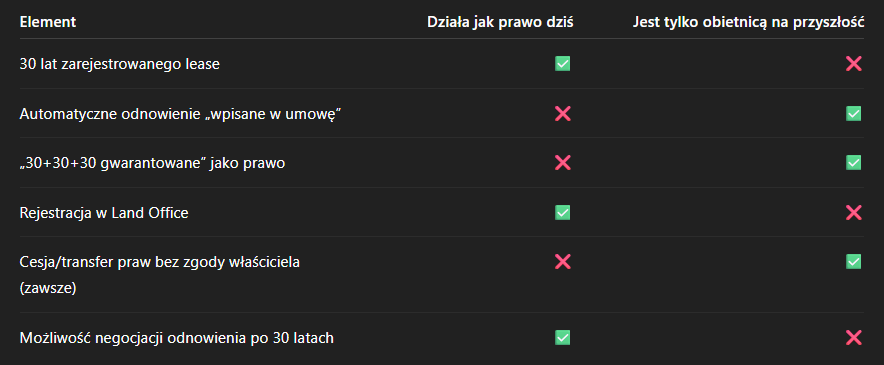
Clauses You Must Watch Out For (and Why They Hurt Investors)
Below is a list of clauses and structures that in practice most commonly compromise leasehold security. This isn't a "theoretical" list — these are things actually seen in offers.
- Prohibition on Assignment/Rights Transfer Without Landowner Consent
- If you cannot transfer the lease without landowner consent, your "sale" becomes a negotiation with someone who has leverage.
- Penalties and Fees for Assignment Consent
- Often looks innocent: "administration fee." In practice, it becomes a control tool and extra costs when exiting the investment.
- Unclear Sublease Rules
- If the contract doesn't explicitly state you can rent out (or says only with owner consent), your rental model is legally fragile.
- "Renewal Clause" Marketed as Guarantee
- If someone says renewal is "certain," ask them to show the enforceability mechanism. After recent market signals and judgment commentary, automatic renewals are treated very cautiously. (Silk Legal)
- Prepayments for Subsequent Periods
- If you're paying today for something meant to happen in 30 years, you're financing the other party's risk.
- Lack of Registration
- This is classic. Everything looks good until there's a dispute. Registration is the foundation of long-term lease enforceability. (Lexology)
- Imprecise Description of Leased Property
- Villas on Koh Samui often have elements: building, land, access, infrastructure rights. If it's unclear exactly what the lease covers, the risk is operational, not just legal.
- "Soft" Contract Termination Clauses
- If the owner has broad contract termination possibilities for minor breaches, your security is illusory.
3 Facts You Must Know: Thailand Leasehold
Fact 1: 30 years is the hard limit for standard property lease. (Thailand Law Library)
Fact 2: Leases exceeding 3 years must be registered, otherwise their protection is limited. (Lexology)
Fact 3: "30+30+30" as an automatic guarantee is not the same as a right to 90 years. (Silk Legal)
Investor Checklist: Thailand (Koh Samui) — 5 Verification Points
- Is the lease registered at the Land Office for the full 30 years?
- Does the contract allow subletting and clearly describe rental terms?
- Can you execute lease assignment without discretionary landowner consent (or with a clear, limited mechanism)?
- Does the contract lack "renewal" marketed as guarantee (and do you understand it's not a right today)?
- Is the lease subject description (land/building/access/infrastructure) precise and consistent with project documents?
Summary: What You Buy vs. What You Don't Buy
Leasehold in Thailand is a tool that works when treated honestly: as a right to time and usage, not as "ownership with a different name." If the contract is registered, rights are clear, and assignment and rental mechanisms aren't blocked — leasehold can be a reasonable investment foundation on Koh Samui.
But you must keep one boundary in mind: you're buying 30 years of rights. You're not buying guaranteed future beyond year 30. What comes after that boundary is negotiation and risk — and therefore must be priced as risk, not as certainty.
Sources
https://library.siam-legal.com/thai-law/civil-and-commercial-code-exchange-section-537-545/
https://asean.org/wp-content/uploads/2016/08/Thailand199.pdf
https://www.lexology.com/library/detail.aspx?g=79b61b8d-a114-4446-b2ac-8de11a10f2dc
https://www.lexology.com/library/detail.aspx?g=f247bea2-75d6-4683-99c7-398bb634e59f
https://anglosiamlegal.com/lease-agreements/
https://phuketnewsproperty.com/303030-leasehold-thailand-risks/
https://benoit-partners.com/thailand-30-years-lease-agreements/
Get personalized property recommendations
Our advisor will prepare a selection of properties matching your criteria and budget.
- 3-5 hand-picked properties matching your criteria
- Full cost analysis and investment potential overview
- Free consultation with a dedicated advisor