Resale Condo in Thailand or New from the Developer: What to Check
A resale condo in Thailand is bought on a negotiated contract, while a new unit from the developer comes on a standard form with a warranty. Both end in the same way, with registration at the Land Office, but on a resale you check more yourself: the title, the no-arrears letter, the foreign quota and the split of costs with the seller. Below are a comparison, a checklist and dated cost data.
We are an international real estate agency with offices in Thailand and Cambodia. Our database is mostly developer projects, so we have no statistics for second-hand prices and we do not claim that resale is cheaper or more expensive.
Resale condo or new: the short answer
- A new unit from the developer has a standard contract form (Or.Chor. 22), a warranty and penalties for delay. In return you pay according to the schedule in the contract and wait for handover.
- A resale unit you can view, examine and take over at once, but the contract is negotiated, so you watch its content. Protection comes mainly from the Civil and Commercial Code (hidden defects, a one-year limit).
- Costs differ on the seller's side. If the seller has held the unit under 5 years they pay specific business tax of 3.3%, after 5 years stamp duty of 0.5%, and both customarily fall on the seller.
- A foreigner needs free room in the 49% quota. Get it in writing from the juristic person before the deposit.
Comparison: new from the developer versus resale
| Criterion | New unit from the developer | Resale unit |
|---|---|---|
| Contract | standard form Or.Chor. 22 (section 6/2 of the Condominium Act), terms worse for the buyer have no effect | freely negotiated, so review by your own lawyer matters more |
| Warranty | at least 5 years structure, 2 years the rest (sources differ on when it starts) | hidden defects under sections 472-474 CCC, claim within one year of discovery; whether any developer warranty is left depends on the contract |
| 2% transfer fee | the developer may pass at most half to you | split is negotiable, customarily half each |
| Seller's taxes | the developer's side | SBT or stamp duty plus withholding tax, usually paid by the seller |
| Who checks the unit | you, at handover | you, before the deposit and before transfer |
| Delay | penalty of at least 0.01% of the price a day, up to 10% | not applicable, the unit already exists |
The rules for new units are described by Thai Law Online (page updated 15 November 2026). On a resale, protection rests on sections 472-474 of the Civil and Commercial Code in Siam Legal's translation: the seller is liable for a defect impairing value or fitness, but not if the buyer knew of the defect or could have noticed it with ordinary care. A claim prescribes one year after discovery. Because the developer warranty in the described form runs from registration of the condominium, part of the period may already have passed in an older unit. Check the building's registration date and ask whether the seller passes on any warranty rights.
Purchase costs and who pays (as of 18.11.2026)
According to PropertyScout (26 September 2026) the transfer fee is 2% of the assessed value. The temporary cut to 0.01% (until 30 June 2027) covers only Thai nationals and units up to 7 million THB, so a foreigner counts on 2%. The split is not set by law: it is customarily shared equally, and on a new unit the developer may, according to The Thaiger (updated 26 August 2026), pass at most half to the buyer.
The seller's taxes depend on how long they have held the unit:
| Seller's situation | Charge | Who usually pays |
|---|---|---|
| Held the unit under 5 years | specific business tax 3.3% (3% plus 10% municipal tax), on the higher of the sale price and the assessed value | seller |
| Held it over 5 years (or lived in it, registered at the address, for at least a year) | stamp duty of 0.5% instead of SBT | seller |
| Whenever an individual sells | withholding tax calculated by the Revenue Department method | seller |
The five-year rule is confirmed by Royal Decree No. 342 of 1998 (section 4(6), with exceptions including inheritance and the seller's own registered residence). The rate of 3% plus 10% municipal tax is given by PwC (reviewed 24 August 2026). According to PropertyScout, withholding tax is calculated on the assessed value with a flat allowance falling from 92% at one year of ownership to 50% at eight years or more, and you can check the amount in the Revenue Department's calculator.
A worked example (an illustration, not an offer): a unit with a price and assessed value of 5,000,000 THB. The 2% transfer fee is 100,000 THB (about EUR 2,689). If the seller has held the unit for 3 years, 3.3% SBT is 165,000 THB (about EUR 4,437). After 5 years, stamp duty of 0.5% replaces SBT, which is 25,000 THB (about EUR 672). Since this is usually the seller's cost, it feeds into their asking price, so write each item separately into the contract, because the law does not fix the split. For a wider discussion of charges see who pays the transfer fee in Thailand.
Exchange rate used: NBP table 223/A/NBP/2026 of 17 November 2026, 1 EUR = 37.19 THB.
Checklist for a resale unit
- Title. Order a title search and check who the registered owner is and whether there are mortgages or encumbrances (The Thaiger recommends a title search and a check of permits).
- No-arrears letter. The seller should provide a letter from the juristic person confirming that no fees are outstanding. Without it the transfer will not go through, so demand it before the deposit.
- Foreign quota (49%). Ask the juristic person for written confirmation that there is room. We cover the rules in our post on the 49% quota.
- Accounts and sinking fund. Read the juristic person's statements, the size of the fund and the rules on pets, renovations and parking.
- Technical condition. Inspect as at handover: damp, installations, air conditioning. Because a resale has a negotiated contract, put any defects you find into the price or the contract.
- Money from abroad. The FET form is issued by the receiving bank for transfers of USD 50,000 or more (according to The Thaiger). See our FET form guide.
- Attorney and documents. If you cannot attend on the transfer day you need a power of attorney (form Tor Dor 21), and a marriage certificate where relevant.
This is a summary. The full procedure is in Thailand Property Due Diligence: 7 Steps. Our guide does not replace a lawyer who reads the specific contract.
Negotiation, furniture and price
On a resale, the final price and the contents are a matter of negotiation. List in the contract what stays in the unit (furniture, air-conditioners, appliances) and do the same for its technical condition. In a developer project, ask what the price includes (furnishing, payment schedule) and compare the total cost, not just the price per square metre.
We have no second-hand price data in our dataset. So we show only a reference point from our database of developer projects (as of 18 November 2026, starting asking prices, not transaction prices): the median starting price of a Phuket condo is 5,332,000 THB (about EUR 143,400), in Pattaya 3,475,200 THB (about EUR 93,400) and in Bangkok 11,700,000 THB (about EUR 314,600). Do not compare them directly with a resale listing, because age, location and size differ. Without that comparison, we promise no saving on either side.
Who each option suits
You would choose a new unit from the developer if you want a standard contract with a warranty, do not mind waiting for handover and prefer the developer to carry the risk of delay. See also condo handover inspection.
You would choose a resale if you want to see a finished unit and the building in operation (the juristic person's accounts, the neighbours, the real fees), are ready to negotiate the contract and have a lawyer to check the documents.
Frequently asked questions
Who pays the tax when a condo is sold in Thailand?
Customarily the seller: specific business tax of 3.3% if held under 5 years, or stamp duty of 0.5%, plus withholding tax. The law does not fix the split, so write each item into the contract.
Does a foreigner benefit from the transfer fee cut to 0.01%?
No. According to PropertyScout (26 September 2026) the cut until 30 June 2027 applies only to Thai nationals and units up to 7 million THB, so a foreigner pays the usual 2%.
Which letters should I collect when buying a second-hand unit?
A letter from the juristic person confirming no arrears, written confirmation of free room in the foreign quota, a title search extract, and the FET form for a transfer from abroad. Demand them before the deposit.
Does a resale unit still have the developer's warranty?
That depends on the contract and the building's registration date, because the developer's warranty in the described form runs from registration of the condominium. Separately, you have protection under sections 472-474 of the Civil and Commercial Code, with a one-year limit on the claim.
Want to compare new projects from our offer with your budget? Contact us. See also condos in Bangkok and condos in Pattaya. This is general information, not legal or tax advice. Before buying, consult an independent lawyer or tax adviser.
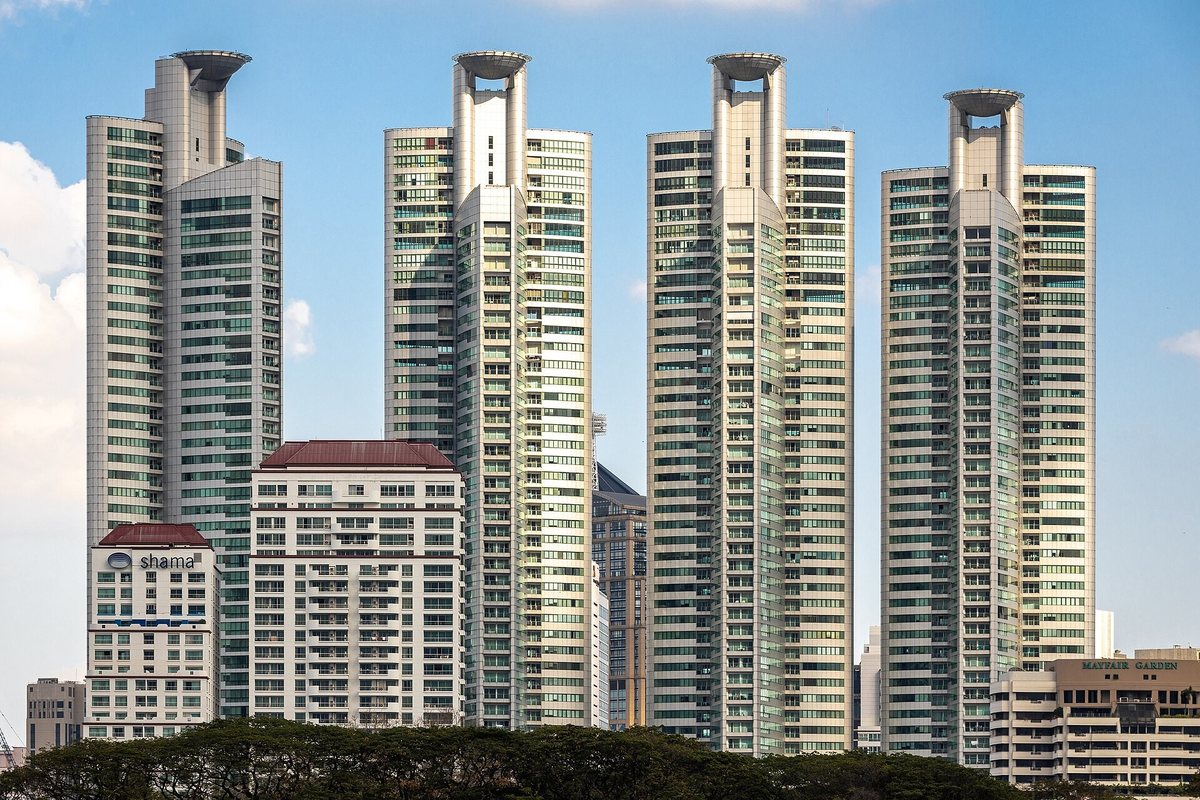
Cover photo: Supanut Arunoprayote, CC BY 4.0, Wikimedia Commons.